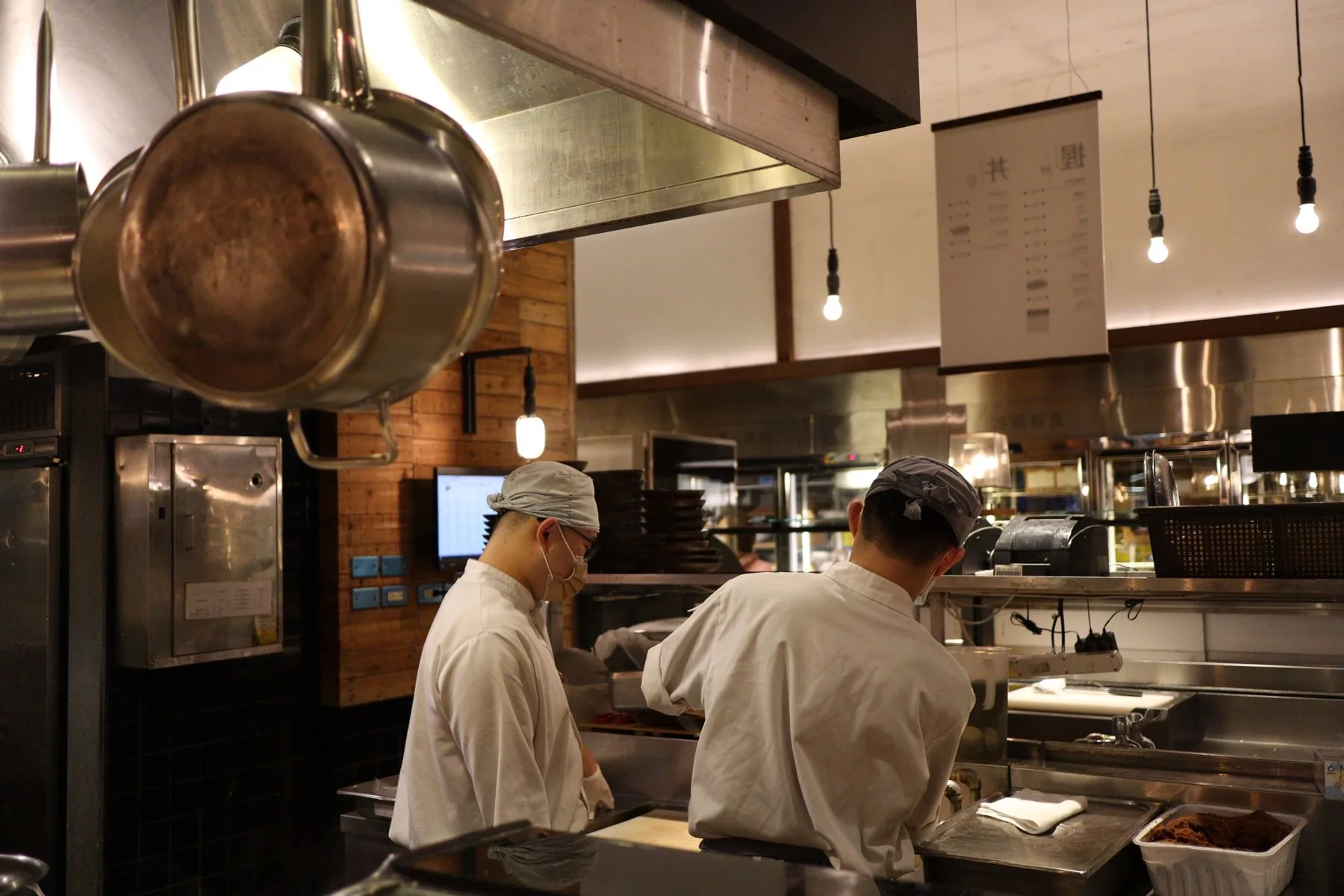
In many restaurant kitchens, trained chefs spend much of the day restocking fridges, portioning dressings, cutting standard garnishes and repeating the same mise en place. These tasks must be completed properly, hygienically and on time. But does every step require professional training, or does some of the work primarily require clear standards, good instruction and capable hands?
The same pattern appears in cafés, canteens and hotels. A head chef may be occupied with routine preparation or restocking while menu development, purchasing, training, quality control and waste analysis are postponed. Hotel breakfast is a clear example, but far from the only one.
The problem is not that the employee is too skilled. A highly trained employee can perform almost any task. The problem is paying for professional judgement and then using it almost exclusively for repetition.
The right question is not, ‘How many chefs can we do without?’ It is, ‘Which tasks require a chef, which can be taught, and where should professional oversight sit?’
Untrained must never mean unprepared
It is both legal and common for employees without formal culinary qualifications to handle many food-related tasks. Their job title does not, however, relieve the business of its responsibilities.
The Danish Veterinary and Food Administration states that anyone handling or selling food must receive instruction or training in safe food handling, personal hygiene and the business's food safety procedures. Every employee must be able to perform their work in compliance with the rules. The authority also explains that on-the-job training and instruction in the business's established procedures may often be sufficient, provided that instruction is maintained and refreshed over time.
The Danish Working Environment Authority emphasises that training must suit both the task and the employee's circumstances, including their education, age and language skills. The employer must also confirm that the instructions have been understood and supervise the work.
A laminated checklist is therefore not training in itself. Situational leadership offers a useful framework: an employee needs closer instruction when learning a new task and greater independence once their competence has been demonstrated. Gastroplan can train managers to apply this principle to the restaurant's actual stations and employees.
Not every kitchen task requires the same skill level
The US Bureau of Labor Statistics, for example, distinguishes between food preparation workers, who may prepare cold dishes, cut fruit and vegetables, brew coffee and restock buffets, and chefs and head cooks, who plan menus, develop recipes, oversee quality, order supplies, and lead and train staff. This is not a Danish staffing rule, but it illustrates a useful way to divide kitchen work.
A 2025 US occupational survey found that 95.6 per cent of jobs in food preparation and serving required on-the-job training, while 81.6 per cent had no formal minimum education requirement. The figures cannot be transferred directly to Denmark, but they support the central point: many tasks can be learned on the job, but they cannot simply be handed over without training.
BLS illustrates the distinction between production and professional responsibility: food preparation workers typically work under professional supervision, while chefs and head cooks are responsible for areas such as recipes, quality, purchasing and training.
A restaurant can begin with the following division of tasks:
| Task level | Examples | Who can typically perform it? | Required control |
|---|---|---|---|
| 1. Repeatable preparation | Restocking dry goods, portioning butter and dressings, setting up for service and packing standard orders | Trained unqualified employee, assistant or apprentice | Visual standard, quantity and cleanliness |
| 2. Trained routine | Cutting fruit and vegetables, completing fixed mise en place, baking prepared items and recording temperatures | Employee approved for the specific task | Hygiene, allergens, temperature, tools and spot checks |
| 3. Professional production | Sauces, hot production, adjusting consistency, handling exceptions and dishes cooked to order | Qualified or demonstrably competent employee | Professional judgement and clear responsibility |
| 4. Management and development | Menu, costing, purchasing, production planning, quality, training and waste analysis | Head chef, sous-chef or another responsible manager | Results, finances and follow-up |
The boundaries depend on the concept. A standardised sandwich is not the same as a complex dish cooked to order, and routine restocking is not the same as safely managing an allergen order. The task – not pride or job title – should determine the required level of competence.
The pattern runs through the entire operating day
Resource allocation can be reviewed before, during and after service:
- Before service: goods receiving, restocking, standard portioning and repeatable mise en place can often be taught and released to employees in stages.
- During service: simple assembly, packaging, standard cold dishes and restocking can be handled by a trained employee, while professional expertise is concentrated on hot stations, flavour, pace and exceptions.
- After service: chilling, labelling, stock counts, cleaning and waste recording can be allocated according to clear standards and control points.
- At hotel breakfast: buffet restocking and cold preparation can be separated from hot production, special diets, allergen handling and dishes cooked to order.
When routine work and professional responsibility are mixed together, the most expensive or experienced employee can easily end up doing everything. Separate them too rigidly, however, and quality and food safety may suffer. The practical answer is a skills mix: a professionally responsible employee sets the standard, handles higher-risk decisions and provides oversight, while trained colleagues carry out approved routine tasks.
An operating plan can bring together expected sales or customer numbers, historical consumption, mise en place, visual standards, restocking intervals and exception handling. Its value does not lie in the number of checklists. It lies in translating professional experience into an understandable standard against which others can be trained and assessed. Detailed fields and control points therefore belong in a working tool rather than in the middle of an article.
Standardisation can reduce both waste and firefighting
A German field study followed four hotel kitchens for 12 months. When employees recorded breakfast buffet leftovers and changed their daily routines, leftovers fell by an average of more than 64 per cent. One change was to use smaller, demand-led refills during the final half-hour of breakfast. The researchers calculated annual savings of approximately EUR 9,000 per kitchen.
The study does not establish how a restaurant or hotel should be staffed. It demonstrates something equally important: measurement and simple changes to daily routines can significantly alter resource consumption.
Four German hotels measured their waste: the study published in Industrial Marketing Management found that continuous recording and small operational changes more than halved breakfast buffet leftovers.
The same principle can be applied to working time in restaurants, cafés, canteens and hotels. Record how many minutes are spent on selected products and workflows, how often items are replenished, and how much is discarded. Staffing can then follow actual consumption and workload rather than inherited habits.
What does the pay difference mean in your operation?
Restaurants are not all covered by the same collective agreement. Denmark has no statutory minimum wage, and pay and employment terms are generally governed either by a collective agreement or by an individual agreement between employer and employee. One restaurant may be bound through membership of an employers' organisation, an accession agreement or a company-level agreement, while another may have no collective agreement. HORESTA itself offers membership options both with and without collective agreement coverage.
A published collective-agreement rate should therefore be treated as a reference point, not as the answer for the entire industry. Under the public restaurant agreement between HORESTA and 3F, the minimum hourly rates from 1 March 2026 are DKK 165.07 for a qualified gastronomy professional, DKK 150.52 for an unqualified gastronomy worker and DKK 148.49 for an assistant. Within this particular agreement, the differences in base hourly pay are DKK 14.55 and DKK 16.58 respectively.
The agreement also states that the minimum rate is the starting point for an individual pay negotiation and that higher pay is expected. Responsibility, experience, length of service, education, performance and the nature of the work must all be considered. Supplements, pension, holiday, absence, training and local agreements also affect the true hourly cost.
Use your own payroll data: Official Danish guidance explains that Denmark has no statutory minimum wage. The Restaurant Collective Agreement 2025–2028 documents categories and minimum rates for businesses within its scope. Neither source proves that every unqualified employee costs less than every qualified one.
If a business following these rates reallocates six hours a day for 300 days from a qualified gastronomy professional to an assistant, the difference in base pay is approximately DKK 29,800 a year. This is only an illustrative calculation – not a promised saving and not a picture of every restaurant's pay structure.
The greatest benefit may be what the chef does with the time released: improve purchasing, reduce waste, prevent errors, raise quality, speed up service or train more employees. If the hours are simply left empty on the rota, the capacity has not been converted into value.
Use the following calculation:
Annual impact = reallocated staffing hours × difference in total hourly cost + documented value of released professional time − training, supervision and errors
Measure speed after training – not before
An experienced chef will almost always be faster than a new employee on day one. That comparison only reveals who has had more practice. A meaningful assessment requires a clearly defined task and quality standard, genuine training, and a comparison of time, errors, waste and the need for assistance only once the employee can perform the task independently.
The relevant measure is not simply minutes per portion or finished unit:
True time per approved unit = working time + corrections + time lost to waste + active supervision / number of approved units
An unqualified employee who needs constant assistance is not inexpensive to employ. An experienced assistant who delivers consistent quality may be more valuable at a particular station than a qualified chef who works there only occasionally.
An internal skills ladder makes development visible
A restaurant can define the progression from working alongside a trainer to independent execution, responsibility for a station and, ultimately, authorisation to train others. This makes it clear what each employee has actually been approved to do and gives management a better basis for choosing the right support and supervision for a particular task.
This resembles the gradual development associated with an apprentice, but the forms of employment must not be confused. A gastronomy apprentice follows a formal programme combining college and workplace training, governed by a training agreement and specific pay and contractual terms. The Danish Ministry of Children and Education explains that the apprentice must have a training agreement with an approved company. Section 55 of the Danish Vocational Education and Training Act states, among other things, that the apprentice's pay must be included in the agreement and must at least match the relevant collective agreement for the training field.
An apprentice is therefore not simply a cheaper person on the rota. The business has accepted a responsibility to provide training. Nor does an unqualified employee become an apprentice merely because they are learning new tasks at work.
When is hiring more qualified chefs the right choice?
A skills mix must not become a race to employ as few qualified chefs as possible. More qualified chefs, or a stronger head-chef presence, make sense when a large part of the menu is cooked to order, quality depends on continuous tasting and adjustment, or customers expect special orders and high-end products prepared on demand. The same applies when allergens and special diets require close professional control, the range changes frequently, or the business has many new employees but too few capable trainers. The greater the potential consequences of a professional error for the customer, reputation or finances, the stronger the case for experienced professional oversight.
A service checklist can specify sequence, quantity and timing. It cannot give a new employee practical skill or judgement in five minutes. Standardisation is strongest where work is repeatable; professional expertise is strongest when reality departs from the plan.
How a restaurant consultant can help
A restaurant consultant should not begin by proposing fewer employees. Operations must first be observed and measured. Gastroplan's restaurant consultants can map tasks before, during and after service, distinguish routine work from professional judgement, and calculate consumption, production volumes and labour hours. Standards, training and competence levels can then be tested in real operations, so the change is assessed on quality, waste, working conditions and finances – not merely the wage rate.
The aim is not to make employees interchangeable. It is to make expectations clear enough for more people to succeed – and to give qualified staff time for the work where their experience makes the greatest difference.
Frequently asked questions about restaurant and hotel staffing
Can an unqualified kitchen employee handle food?
Yes. Many tasks can be performed by an employee without formal culinary qualifications. The business must provide relevant instruction or training in food handling, hygiene and its food safety procedures, and the employee must be able to perform the specific task safely.
Is an unqualified employee always less expensive than a qualified one?
No. Published minimum rates may be lower under a particular collective agreement, but actual pay depends on factors such as experience, responsibility, individual pay, supplements and the applicable agreement. Training, mistakes, supervision and staff turnover must also be included in the calculation.
Does a restaurant have to enter into a collective agreement?
No. Danish businesses are not generally required by law to enter into a collective agreement. A restaurant may, however, already be bound through membership, an accession agreement or a company-level agreement. Any wage calculation must therefore begin with the business's own contracts, agreements and legal obligations.
Can a checklist replace a chef?
No. A good checklist can transfer an established standard and reduce variation. It cannot assess flavour, respond to an unfamiliar exception or assume responsibility for food safety. The checklist must therefore be combined with training, supervision and a clear escalation route.
Conclusion: use professional expertise where it creates value
Every kitchen task must be performed with respect for hygiene, quality and the customer. Respecting the task does not automatically mean that a qualified chef or head chef must perform every step.
A robust staffing model makes tasks and standards visible, adapts management to the employee's actual competence, and maintains professional oversight when risk and variation require it. Only then does it make sense to compare time, mistakes, waste and customer experience.
Staff optimisation then stops being a search for the lowest hourly wage. It becomes a way to use every employee's time and potential more effectively.
Sources and further reading
- Danish Veterinary and Food Administration: Training staff in food businesses
- Danish Veterinary and Food Administration: Personal hygiene in food businesses
- Danish Working Environment Authority: Systematic health and safety work, training and instruction
- Danish Working Environment Authority: Allocation of tasks and roles
- Center for Leadership Studies: Situational Leadership
- HORESTA and 3F: Restaurant Collective Agreement 2025–2028
- Life in Denmark: Pay in Denmark – collective agreement or individual contract
- Life in Denmark: The Danish labour market model
- HORESTA: Membership with and without collective agreement coverage
- Danish Ministry of Children and Education: Training agreements
- Retsinformation: Danish Vocational Education and Training Act, section 55
- US Bureau of Labor Statistics: Food Preparation Workers
- US Bureau of Labor Statistics: Chefs and Head Cooks
- US Bureau of Labor Statistics: Occupational Requirements Survey 2025
- Juvan et al.: Reducing food waste in hotel kitchens based on self-reported data