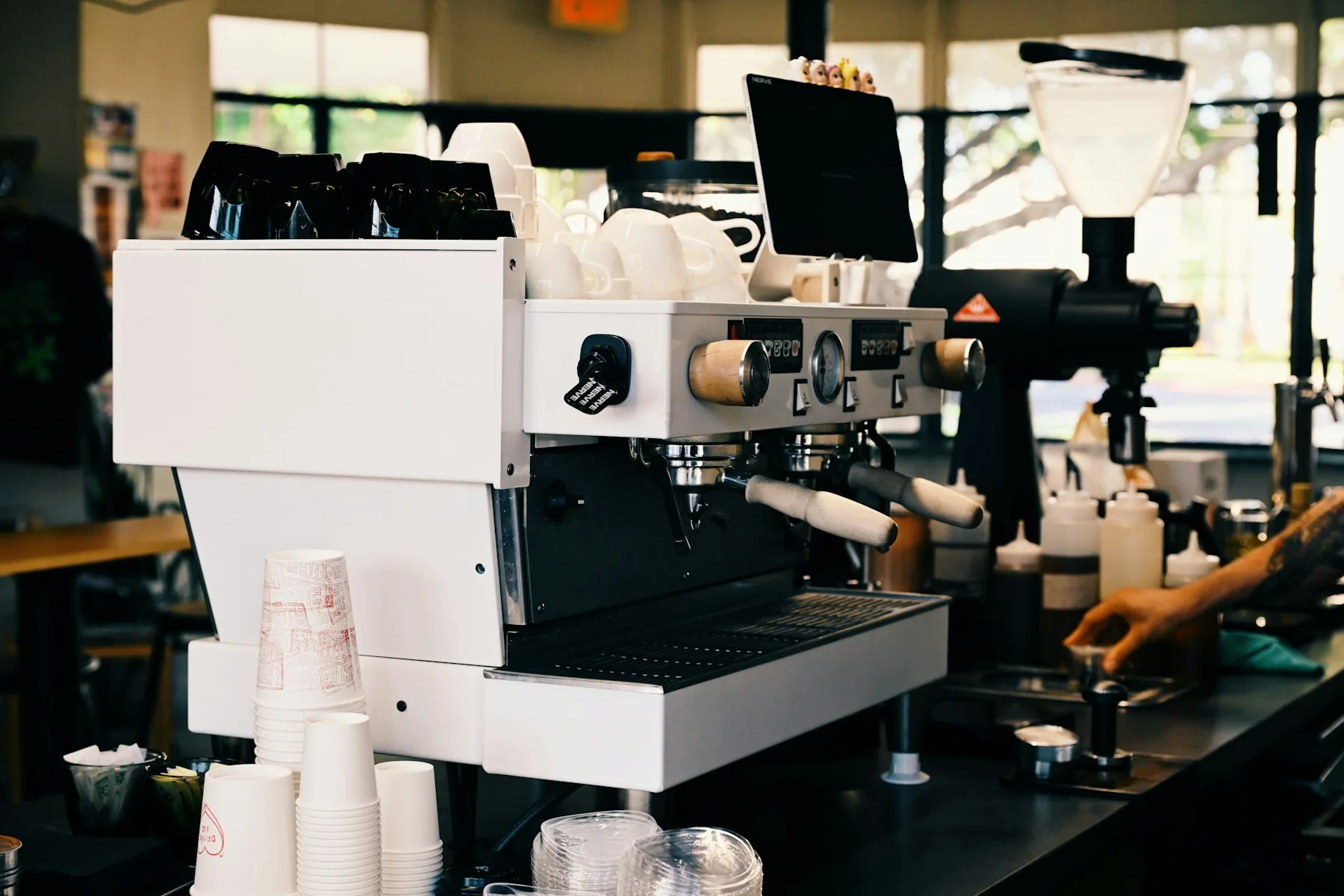
The professional espresso machine has become an almost automatic choice for restaurants. It signals craftsmanship and can produce excellent coffee.
But it requires space, a grinder, adjustment, tamping, milk steaming, cleaning and training. If the restaurant sells few cups, or 80 function guests want coffee at once, the prestigious machine can become a slow and expensive solution.
The question, then, is not which machine can make the best espresso under ideal conditions. It is:
Which solution delivers the quality customers expect at the restaurant's actual volume, staffing level and price point?
An espresso takes more than 25 seconds
The Specialty Coffee Association describes a classic espresso as having a brew time of 20-30 seconds. In an international survey of baristas, 51 per cent of respondents reported an average extraction time of between 25 and 30 seconds.
That is only the time during which water passes through the coffee. Before and after extraction, staff must also empty the portafilter, grind, dose, tamp, steam milk, assemble the drink, rinse and serve.
The Specialty Coffee Association measures extraction: The SCA specifies a brew time of 20-30 seconds. This figure does not cover the full production and service process.
A 2025 study from the University of Louisville followed the ordering process from start to final delivery in three coffee shops. The study's time models had intercepts of approximately 1.38-2.06 minutes, but the measurements covered complete orders and cannot be read as a fixed time for a single espresso.
The regional chain completed orders roughly twice as quickly as the more craft-led coffee shop at comparable levels of complexity. Custom orders also had a greater effect on the independent coffee shop. Workflow, layout and menu can therefore matter as much as machine speed.
A US time study found: The researchers measured the ordering process in three coffee shops. The results primarily demonstrate the value of standardisation and a simple product mix.
Documented times and capacities
Few independent studies compare every brewing method under the same conditions. Manufacturers' capacity figures can nevertheless provide useful reference points when their limitations are made clear.
| Solution | Documented figure | Converted machine time |
|---|---|---|
| Traditional espresso | 20-30 seconds' extraction | 20-30 seconds plus preparation |
| Scanomat TopBrewer Pro | Up to 90 cups/hour | Approx. 40 seconds per cup |
| WMF 5000 S+ bean-to-cup machine | 144 single or 220 parallel cappuccinos/hour | Approx. 25 or 16 seconds per cup |
| Franke A1000 bean-to-cup machine | 156 single or 224 parallel cappuccinos/hour | Approx. 23 or 16 seconds per cup |
| Nespresso Zenius capsule machine | Up to 70 black coffees/hour | Approx. 51 seconds per cup |
| Bravilor B5 filter machine | 5 litres in 10 minutes | Approx. 15 seconds' brewing time per 125 ml cup in a full batch |
WMF and Franke state capacity according to DIN 18873-2. This creates a more consistent basis for comparison, but the figures do not include positioning cups, serving, refilling, cleaning or operational stoppages.
Two manufacturers show almost identical machine times: The WMF 5000 S+ and Franke A1000 are rated at 144 and 156 single cappuccinos per hour respectively. That equates to machine times of approximately 25 and 23 seconds.
Measure three different times
A restaurant should not rely on a single figure in seconds. Instead, measure:
Machine time: From the moment the machine starts until the drink is ready.
Active staff time: The seconds during which the employee cannot do anything else.
Total service time: From the release of the order until the customer receives the coffee.
A bean-to-cup machine can work while the employee performs another task. On a traditional machine, meanwhile, a skilled barista can prepare the next drink during extraction. Parallel outlets and steaming milk for several drinks together can therefore reduce the time per cup.
Active staff time is the best basis for calculating labour cost. Total service time says more about capacity and customer experience.
What do 10, 50 or 100 cups cost?
The formula is:
Labour cost = number of cups × active seconds per cup / 3,600 × total hourly employment cost
If an employee costs DKK 225 per hour and each coffee requires 30 seconds of active time, the calculation looks like this:
| Number of cups | Total active time | Labour cost |
|---|---|---|
| 1 | 30 sec. | DKK 1.88 |
| 10 | 5 min. | DKK 18.75 |
| 50 | 25 min. | DKK 93.75 |
| 100 | 50 min. | DKK 187.50 |
| 500 | 4 hours 10 min. | DKK 937.50 |
The DKK 225 figure is only an example. The restaurant should use its full hourly employment cost, including wages, pension, holiday pay, supplements and other employer costs.
If several cups are produced at once, use the actual batch time. If an employee makes ten cups in eight active minutes in total, the labour cost is:
8 minutes / 60 × DKK 225 = DKK 30
This is more accurate than multiplying a theoretical single-cup time by ten.
However, working time does not automatically translate into a cash saving. An employee will not necessarily go home earlier because the coffee machine is faster. The time only acquires economic value if it is used for other tasks, generates additional sales or reduces the need for extra staff at peak times.
For example, assume the restaurant sells 40 milk-based coffees a day. If active time is reduced from 75 to 15 seconds per cup, 40 staff minutes are released each day. At DKK 225 per hour, that equates to DKK 150 a day or DKK 45,000 over 300 opening days.
The DKK 45,000 is a capacity value, not a promise of an additional DKK 45,000 on the bottom line. But the amount can be used to assess whether a more expensive bean-to-cup machine, a better grinder or a more practical workstation can pay for itself.
Payback period = additional investment / annual value of time saved and waste reduced
If a new solution costs an additional DKK 90,000 and releases capacity with a documented annual value of DKK 45,000, the simple payback period is two years. Service, financing, electricity and residual value must then be included in the final assessment.
When 80 customers want coffee at once
Serving 125 ml of black coffee to 80 customers requires 10 litres:
- A professional Bravilor B10 can brew this quantity in approximately 10 minutes.
- A Nespresso Zenius with a stated capacity of 70 cups per hour would theoretically need just under 69 minutes.
- A WMF 5000 S+ would theoretically need about 33 minutes with a single outlet or 22 minutes at full parallel capacity.
- Traditional espresso depends on the number of group heads, double shots, product mix and the barista's workflow. Extraction time alone cannot tell you when customer number 80 will receive their coffee.
These times are idealised. Cups still need to be positioned, carried out and cleared. Filter coffee also brings a risk of overproduction and excessive time on the hotplate. But for large parties ordering simultaneously, batch brewing is often the rational choice if the quality suits the concept.
There is also a difference between 80 cups spread over an entire evening and 80 cups ordered within ten minutes. Total daily volume determines ingredient requirements and machine durability. Peak demand determines the number of outlets, staffing and service format. A restaurant can therefore have low daily coffee sales yet still need high batch capacity if functions form a major part of its business.
Batch brewing changes capacity: Bravilor specifies 10 litres in approximately 10 minutes for the B10 and 5 litres in approximately 10 minutes for the B5.
Which solution suits which restaurant?
| Solution | Makes particular sense when | Main risk |
|---|---|---|
| Traditional espresso machine | Coffee is part of the concept, volume is stable and staff are trained | Slow and inconsistent coffee when the machine is used infrequently |
| Bean-to-cup machine | The restaurant has changing staff and many individual orders | High investment and technical maintenance |
| Capsule machine | Volume is low or uneven and space is limited | High ingredient cost and low capacity for large parties |
| Filter/batch | Many customers need coffee at the same time | Waste and loss of quality if the batch size is wrong |
| French press | Smaller parties want full-bodied coffee served at the table | Manual cleaning and steeping time |
Research into brewing methods shows that espresso, filter coffee and French press produce different sensory profiles, not simply good and bad versions of the same product. The choice should therefore match customer expectations.
A research review found: A recent review explains how brewing methods produce different physical and sensory profiles.
Traditional espresso: When the craftsmanship can be sold
A manual or semi-automatic machine is a strong choice for cafés, brunch venues and Italian restaurants where coffee is a visible part of the identity. Here, the barista's craftsmanship, the aroma, the sound and the customer's ability to watch the preparation can have value in their own right.
The solution becomes weak when the machine is used infrequently by many different employees. The grinder must be adjusted, milk steaming must become second nature and the station must be kept clean. An expensive machine does not compensate for a lack of routine.
Bean-to-cup: Consistency and hands freed up
A professional bean-to-cup machine standardises dosing, extraction and milk. This makes it relevant when employees are primarily waiters or hosts rather than baristas.
Another advantage is that the employee can position the cup, start the drink and perform another task. The machine still requires daily cleaning, water treatment, servicing and refilling. A technical failure can halt all coffee production if the restaurant has no backup solution.
Capsules: Rational for low and uneven sales
Capsules have a higher ingredient cost and create packaging waste, but dosing is consistent, training is brief and the initial investment often lower. For private dining, meetings or a small number of cups each day, the overall economics may therefore be better than those of a large espresso station.
Capacity becomes the challenge when many customers order at once. Milk-based drinks also require a separate or integrated milk solution, which can remove some of the simplicity.
Filter coffee: A production choice, not a defeat for quality
Filter coffee does not become poor simply because it is brewed in a batch. It becomes poor through incorrect dosing, dirty equipment or being kept hot for too long. Fresh beans, correct grinding, water quality and a batch size matched to sales are essential.
For functions, good filter coffee can provide a better experience than 80 individual espressos arriving over a long period. The batch plan simply needs to ensure that the final cup is not stale and that large quantities are not poured away.
Run your own 20-cup time study
International figures are useful reference points. Your restaurant's own measurements matter more:
Make 20 drinks in the product mix customers actually order.
Record machine time, active staff time and total time separately.
Include milk, refilling, errors and remakes.
Allocate daily cleaning time across the day's cups.
Repeat the test with one experienced and one less experienced employee.
Test under a realistic peak load, not in an empty restaurant.
Then compare the total cost per cup:
Ingredients + staff time + cleaning + service + depreciation + waste + space
A capsule may cost more in ingredients yet still be cheaper overall at very low volumes. A traditional espresso machine can be expensive and still be the right choice if coffee sales, pricing and brand value are high.
Also record the split between black coffee and milk-based drinks. An average of 40 cups says too little if 30 are quick espressos and ten are time-consuming custom orders. The product mix determines ingredient use, cleaning and capacity.
Conclusion: Buy the quality you need
The research does not provide one universal number of seconds per coffee. It shows why the entire workflow must be measured. The manufacturer's capacity figure shows the machine's ceiling; the restaurant's own time study shows whether the solution actually makes sense.
Choose traditional espresso when craftsmanship is an important part of the concept. Choose bean-to-cup, capsules or filter coffee when they meet the customer's needs more effectively. Customers are paying for a satisfying end to their meal, not for the size of the machine.
Sources and further reading
- Specialty Coffee Association: Defining the Ever-Changing Espresso
- University of Louisville: Time study of three coffee shops
- WMF 5000 S+: Capacity according to DIN 18873-2
- Franke A1000: Capacity according to DIN 18873
- Nespresso Professional Zenius
- Bravilor B5 and Bravilor B10
- The Impact of Brewing Methods on the Quality of a Cup of Coffee